
Pacific Heights vs Marina: Which San Francisco Neighborhood Is Right for You?
Torn between Pacific Heights and the Marina? We compare pricing, lifestyle, schools, dining, transit, and housing stock in two of San Francisco's most coveted neighborhoods to help you decide which one fits your life.
If you are searching for a home in one of San Francisco's premier residential neighborhoods, there is a good chance two names keep appearing on your shortlist: Pacific Heights and the Marina. Both sit on the northern edge of the city. Both offer stunning architecture, proximity to green space, and access to some of the best dining and shopping in the Bay Area. (For the broader citywide context that shapes pricing in both neighborhoods, see our SF Q1 2026 Market Report.) And both come with price tags that reflect their desirability.
But the similarities can be deceiving. Pacific Heights and the Marina are fundamentally different neighborhoods in character, housing stock, community vibe, and what daily life actually feels like on the ground. Choosing between them is less about which one is "better" and more about which one aligns with the life you want to live.
This guide compares the two neighborhoods across the dimensions that matter most to buyers: pricing and market dynamics, housing stock, lifestyle and walkability, schools, dining and nightlife, transit, and long-term investment potential.
Location and Geography
Pacific Heights
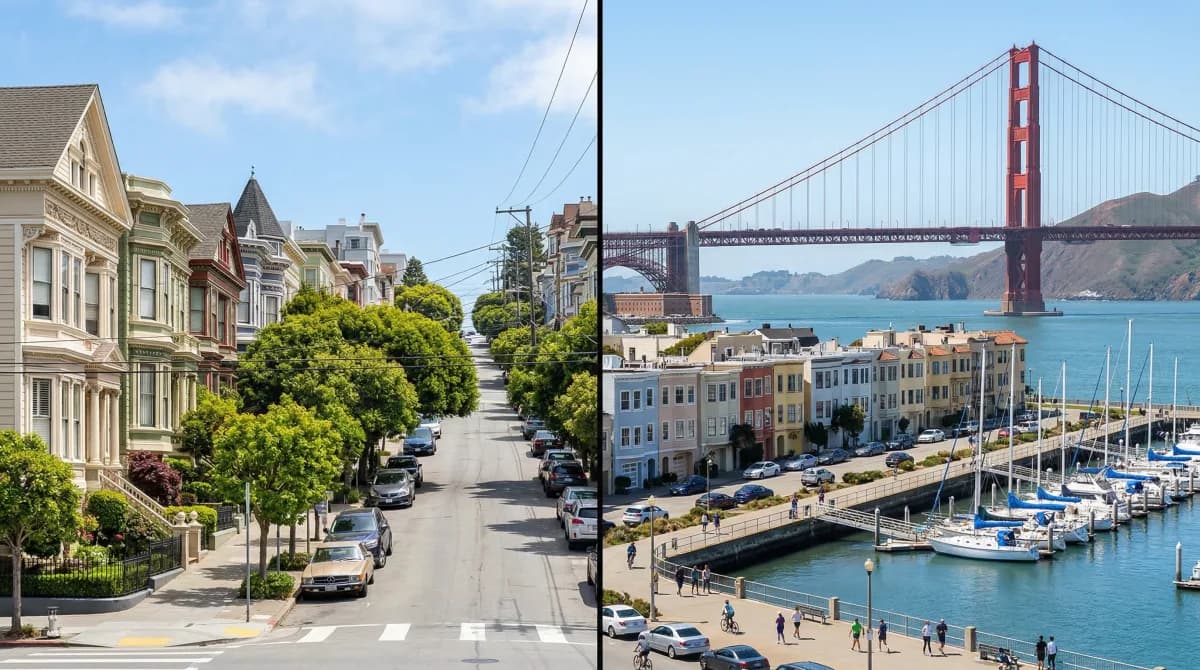
Pacific Heights occupies the high ground, stretching along a ridge between Van Ness Avenue to the east and the Presidio to the west, with California Street as its southern boundary and Broadway defining much of its northern edge. The neighborhood's defining feature is elevation: the hilltop location delivers some of the most spectacular views in the city, with panoramic sightlines to the Bay, Alcatraz, the Golden Gate Bridge, and the Marin Headlands.
The topography also creates distinct micro-neighborhoods. The "Gold Coast" along Broadway commands the highest prices and the most dramatic views. The blocks around Lafayette Park and Alta Plaza Park offer a more residential, park-adjacent experience. Lower Pacific Heights, south of California Street, transitions into a denser, more mixed-use environment with more condos and multi-unit buildings.
The Marina
The Marina sits at sea level on the city's northern waterfront, stretching from Fort Mason on the east to the Presidio on the west. Built largely on filled land from the 1915 Panama-Pacific International Exposition, the neighborhood is flat, walkable, and oriented toward the water. The Marina Green, Crissy Field, and the waterfront promenade define the northern boundary and give the neighborhood its distinctive outdoor lifestyle.
The commercial corridors of Chestnut Street and Union Street (which technically sits at the border with Cow Hollow) anchor the neighborhood's retail and dining scene. The residential streets between these corridors are lined with Mediterranean Revival homes, Edwardian flats, and a smattering of newer construction.
Pricing and Market Dynamics
Pacific Heights by the Numbers
Pacific Heights is one of the most expensive neighborhoods in San Francisco, with reported medians in early 2026 ranging from $1.8 million to $2.4 million depending on the data source and timeframe. Price per square foot typically falls between $1,200 and $1,450.
Across all property types, the neighborhood median hovered near $1.76 million in early 2026, essentially flat year-over-year. The more telling shift is speed: homes went under contract in roughly two weeks on average, more than twice as fast as the prior year. Still, those headline numbers obscure the enormous spread within Pacific Heights. A two-bedroom condo in Lower Pac Heights might trade for $1.2 million, while a single-family home on Broadway could command $10 million or more.
At the top of the market, many of the largest deals never appear on the MLS. Private sales along the Gold Coast regularly exceed $20 million, and at least one off-market transaction near Broadway reportedly crossed the $40 million mark in 2025. For the full Q1 breakdown, see our SF Q1 2026 Market Report.
The Marina by the Numbers
Home values in the Marina have appreciated at a healthy clip, averaging close to $1.96 million in early 2026 with year-over-year gains near 7%. The price band is narrower than in Pacific Heights, though waterfront properties and homes with direct bridge views can push well past $3 million.
Marina Boulevard single-family homes sit at the top of the range. Move inward from the waterfront and pricing moderates; condos and TICs on interior streets offer entry points between roughly $900,000 and $1.5 million.
Price Comparison at a Glance
| Property Type | Pacific Heights | Marina |
|---|---|---|
| Median (all types) | $1.76M | ~$1.96M (avg) |
| Single-family home | $2.5M-$10M+ | $2M-$4M |
| Condo (2BR) | $1.1M-$1.8M | $1.0M-$1.6M |
| TIC (2BR) | $800K-$1.3M | $750K-$1.2M |
| Price per sq ft | $1,200-$1,450 | $1,000-$1,300 |
| YoY appreciation | +0.4% (median) | +6.8% (avg value) |
Note: The Marina's higher average reflects its concentration of single-family and larger properties, while Pacific Heights' all-types median includes a significant number of condos that pull the figure down. Direct comparisons require matching property type and size.
Housing Stock
Pacific Heights
Pacific Heights offers an extraordinarily diverse range of housing types, from grand Edwardian and Victorian mansions to modern luxury condos in full-service buildings. The hilltop streets feature some of the most impressive residential architecture in the western United States, with homes by notable architects including Willis Polk, Ernest Coxhead, and Bernard Maybeck.
Single-family homes tend to be large, often 3,000 to 6,000 square feet or more, and many sit on generous lots by San Francisco standards. These homes frequently include multiple levels, formal entertaining spaces, garden or courtyard areas, and garage parking for two or more cars.
The condo market is equally varied. Pacific Heights is home to several of the city's most prestigious full-service buildings, offering doorman service, concierge, fitness centers, and other amenities. Smaller condo buildings and converted flats provide alternatives at lower price points, particularly in Lower Pacific Heights.
The Marina
The Marina's housing stock has a more cohesive architectural identity. The neighborhood was largely built in the 1920s and 1930s following the 1906 earthquake and the subsequent Panama-Pacific Exposition, resulting in a predominance of Mediterranean Revival, Spanish Colonial, and Stucco-clad homes.
Many of the neighborhood's residential buildings are two-to-four-unit structures, with the upper floors offering the most desirable units (and the best views). Conversions of these buildings have created the Marina's significant inventory of TICs and condos. True single-family homes, while present, are less common than in Pacific Heights.
One distinctive aspect of Marina housing: because the neighborhood sits on filled land, seismic considerations are more pronounced. The 1989 Loma Prieta earthquake caused significant damage in the Marina, and many buildings have since been seismically retrofitted. Buyers should always inquire about retrofit status and soft-story compliance.
Lifestyle and Daily Living
Pacific Heights: Elegant and Established
Life in Pacific Heights has a polished, established quality. The neighborhood is quieter than the Marina, with less foot traffic and a more residential character. The two parks, Lafayette Park and Alta Plaza Park, serve as the neighborhood's social anchors, particularly for families with young children and dog owners.
Fillmore Street provides the primary shopping and dining corridor, with a mix of upscale boutiques, galleries, and restaurants. The stretch between California and Jackson Streets offers some of the city's best independent retail. Sacramento Street, between Divisadero and Lyon, adds another pocket of charming shops and cafes.
The pace is slower here. Weekend mornings involve coffee at Jane on Fillmore or a stroll through the parks. There is less of the scene-and-be-seen energy that characterizes the Marina; the social life tends to be more private, centered around home entertaining and smaller gatherings.
The Marina: Active and Social
The Marina is one of San Francisco's most socially active neighborhoods. Chestnut Street's restaurants, bars, and cafes create a vibrant street scene that draws residents out of their homes and into the neighborhood. The Marina Green, Crissy Field, and the waterfront path create one of the best outdoor recreation corridors in the city, filled on any given weekend with joggers, cyclists, dog walkers, and picnickers.
The neighborhood skews younger than Pacific Heights, with a strong presence of professionals in their late twenties through forties. Fitness culture is prominent, with running clubs, outdoor yoga sessions on the Green, and a general orientation toward active, outdoor living.
The social scene extends beyond the daytime. Chestnut Street's bars and restaurants are busy most evenings, and the neighborhood has a more extroverted, outgoing character than the comparatively reserved Pacific Heights.
| Lifestyle Factor | Pacific Heights | Marina |
|---|---|---|
| Vibe | Elegant, established, quiet | Active, social, vibrant |
| Average resident age | 35-55 | 25-40 |
| Outdoor activity | Parks, strolling | Waterfront, running, cycling |
| Dining scene | Upscale, refined | Casual to mid-range, bustling |
| Social atmosphere | Private entertaining | Restaurants, bars, street life |
| Dog-friendliness | Very good (parks) | Excellent (Marina Green, Crissy Field) |
Schools
Both neighborhoods fall within the San Francisco Unified School District, but the private school landscape is where families often focus.
Pacific Heights
Pacific Heights is home to or near several of the city's most prestigious private schools:
- Town School for Boys (K-8) on Jackson Street
- Hamlin School (K-8 girls) on Broadway
- Stuart Hall for Boys / Convent of the Sacred Heart on Broadway
- Drew School (9-12) on California Street
For public options, Cobb Elementary and Sherman Elementary serve portions of the neighborhood, though many Pacific Heights families opt for private education.
The Marina
The Marina's school options include:
- Marina Middle School (public, 6-8)
- Sherman Elementary (public, K-5), which draws from portions of both neighborhoods
- Cow Hollow School (independent, preschool-8th grade) nearby
Families in the Marina also commonly commute to private schools in Pacific Heights, Presidio Heights, or the broader city.
Both neighborhoods benefit from proximity to the Presidio, which offers outdoor education programs, nature-based learning experiences, and recreation facilities that supplement traditional schooling.
Dining and Nightlife
Pacific Heights
Fillmore Street anchors the dining scene, with notable restaurants including:
- State Bird Provisions (innovative California cuisine, Michelin-starred)
- SPQR (upscale Italian)
- The Snug (neighborhood bistro)
- b. patisserie (acclaimed bakery)
The restaurant scene in Pacific Heights tends toward the refined. Reservations are common, and the atmosphere skews toward date nights and special occasions rather than casual drop-ins.
The Marina
Chestnut Street and the surrounding blocks offer a higher density and variety of dining options:
- A16 (Neapolitan pizza and Southern Italian)
- Lucca Delicatessen (historic Italian deli since 1929)
- Causwells (American brasserie)
- Tacolicious (modern Mexican)
- The Tipsy Pig (gastropub)
The Marina dining scene is more casual and varied, with options ranging from quick counter-service to sit-down restaurants. The bar scene is also more active, with several popular spots along Chestnut and Lombard Streets.
Transit and Commuting
Pacific Heights
Pacific Heights is well-served by Muni bus lines, particularly the 1-California, 3-Jackson, and 22-Fillmore routes. However, the neighborhood's hilltop location can make some destinations feel further away than they appear on a map. Downtown access via the 1-California is reliable but not fast.
Street parking is available but competitive. Most single-family homes and better condo buildings include garage parking, which is a significant amenity given the neighborhood's parking constraints.
For commuters to the Financial District or South of Market, expect a 15-25 minute drive or a 25-35 minute bus ride, depending on time of day and exact origin.
The Marina
The Marina's flat terrain makes it more bikeable and walkable than Pacific Heights. The 28-19th Avenue, 30-Stockton, and 43-Masonic bus routes serve the area, and the neighborhood's proximity to the Golden Gate Bridge makes it well-positioned for commutes to Marin County.
For downtown commuters, the Marina is slightly closer than upper Pacific Heights, with typical drive times of 10-20 minutes and bus commutes of 20-30 minutes. The 30-Stockton line provides a direct connection to downtown and Chinatown.
| Transit Factor | Pacific Heights | Marina |
|---|---|---|
| Walkability | Good (hilly) | Excellent (flat) |
| Bikeability | Moderate (hills) | Very good (flat, bike paths) |
| Downtown commute (driving) | 15-25 min | 10-20 min |
| Downtown commute (transit) | 25-35 min | 20-30 min |
| Marin access | Good | Excellent (near GG Bridge) |
| Parking availability | Competitive | Competitive |
Investment Outlook
Pacific Heights
Pacific Heights has a proven track record of long-term value appreciation. The neighborhood's prestige, limited supply of single-family homes, and desirability among both domestic and international buyers create a durable floor under prices. The ultra-luxury market can be volatile on a quarter-to-quarter basis due to small transaction volumes, but the long-term trajectory has consistently trended upward.
The condo market in Pacific Heights benefits from strong demand from downsizers who want to stay in the neighborhood and from professionals seeking full-service living. Well-maintained buildings with good reserves and desirable amenities tend to appreciate steadily.
The Marina
The Marina's investment profile is strong, with the neighborhood showing 6.8% year-over-year appreciation in early 2026. The neighborhood benefits from consistent demand across buyer demographics, a distinctive lifestyle offering that is difficult to replicate elsewhere in the city, and a housing stock that, while earthquake-sensitive, has largely been retrofitted to modern standards.
TICs in the Marina present a particular opportunity for investment-minded buyers. The price discount relative to condos (typically 15-25%) can be partially recaptured through the condo conversion process, though this is a complex and uncertain path that requires careful planning.
Which Neighborhood Is Right for You?
Choose Pacific Heights If You...
- Value prestige, privacy, and a quieter residential atmosphere
- Want access to the city's best private schools within walking distance
- Prefer grand architecture and larger homes with formal spaces
- Appreciate upscale dining and boutique shopping
- Are buying in the ultra-luxury market ($5M+)
- Prioritize views and hilltop living
- Plan to stay long-term and value stability of investment
Choose the Marina If You...
- Want an active, social, outdoor-oriented lifestyle
- Prioritize walkability and flat terrain
- Are drawn to a younger, more energetic neighborhood vibe
- Value waterfront access and proximity to the Presidio and Crissy Field
- Prefer a more casual dining and social scene
- Are commuting to Marin County or want easier bridge access
- Are looking for entry points through TICs or smaller condos
- Enjoy running, cycling, or other outdoor fitness activities
The Overlap
Both neighborhoods work well for buyers who want:
- Northern San Francisco living with Bay and bridge views
- Walkable access to restaurants, shops, and parks
- Strong long-term appreciation potential
- Proximity to the Presidio
- A neighborhood identity that is distinct and recognizable
The Bottom Line
Pacific Heights and the Marina are both exceptional neighborhoods, but they cater to different priorities and stages of life. Pacific Heights offers elegance, privacy, and institutional prestige. The Marina delivers energy, outdoor access, and a social infrastructure that is hard to match.
The best choice depends not on which neighborhood scores higher on abstract metrics, but on which one matches the way you actually want to live. Our buyer's guide walks through the full process of purchasing in San Francisco's competitive market. Spend time in both. Walk the streets on a weekday morning and a Saturday evening. Talk to residents. The right neighborhood will feel like home before you even start looking at properties.
Ready to explore Pacific Heights or the Marina? The Goodrich Group specializes in San Francisco's premier neighborhoods and can provide personalized guidance on pricing, timing, and strategy. Get in touch to start your search with an agent who knows these neighborhoods inside and out.
Disclaimer: The Goodrich Group and Arthur Goodrich operate as independent real estate professionals. We are not affiliated with, sponsored by, or authorized representatives of any of the developers, resorts, hotels, or entities that may be mentioned in this blog. All information provided is for informational purposes only and is based on publicly available sources, including planning documents, news reports, and other materials in the public domain. While we strive for accuracy, we cannot guarantee that all details are current or complete. Any errors brought to our attention will be promptly reviewed and corrected as appropriate.